How Does Office Water Damage Differ From Residential Water Loss?
Commercial office water damage creates unique challenges that residential jobs don't face. Office spaces typically cover larger square footage, often with open floor plans that allow water to spread quickly across carpeted areas and under modular furniture systems.
The building systems differ too. Most Edmond office buildings run on commercial HVAC with ducted returns that can pull moisture throughout the space. Server rooms, break rooms, and bathrooms concentrate plumbing in specific zones, but a single supply line failure can affect multiple tenant suites. Many offices sit on concrete slab foundations with minimal crawlspace access, making subfloor assessment harder.
Business interruption drives restoration urgency in ways homeowners rarely experience. Every hour an office stays closed costs money in lost productivity, missed client meetings, and employee displacement. We've seen Edmond businesses lose thousands in revenue during multi-day shutdowns.
Documentation requirements also escalate. Commercial insurance policies demand detailed photo logs, moisture readings at multiple intervals, and itemized equipment lists. A homeowner might accept a general estimate, but a business needs line-item accounting for every air mover, dehumidifier, and labor hour.
Contents in offices present different problems than household goods. You're protecting computer equipment, file servers, paper records, and sometimes inventory or product samples. Electronics require different handling than furniture. Sensitive documents may need freeze-drying or specialized drying chambers that typical residential water damage restoration doesn't involve.
Coordination with building management adds another layer. If the office is leased, we work with property managers and sometimes multiple insurance carriers (building policy and tenant policy). Access scheduling becomes critical since we can't always work during business hours without interrupting operations.
What Causes Water Loss in Edmond Office Buildings?
Supply line failures top the list of office water losses we respond to in Edmond. Braided stainless steel toilet supply lines age out after 8-10 years, and many office buildings installed during the early 2000s boom are hitting that replacement window now. A failed toilet line on a second floor can dump 5-8 gallons per minute onto ceiling tiles and.
HVAC condensate issues run a close second. Rooftop units serving commercial spaces generate gallons of condensate daily during Oklahoma summers. Clogged drain lines or disconnected condensate pumps send water into ceiling plenums. We recently worked an office complex off Broadway Extension where a condensate overflow saturated insulation above drop ceilings in four adjacent suites.
Roof leaks become water damage events during heavy rain. Edmond gets intense downpours, especially during spring storm season. Flat or low-slope commercial roofs with aging membrane systems develop weak points around HVAC curbs and drain scuppers. Water pools, finds a seam failure, and drips into the building.
Here are common office water loss causes we see:
- Supply line failures (toilets, sinks, ice makers)
- HVAC condensate overflow or drain clogs
- Roof leaks at membrane seams or penetrations
- Sprinkler system malfunctions or freeze damage
- Water heater tank failures in break rooms
- Exterior door leaks during wind-driven rain
- Plumbing stack leaks from upper floors
- Parking lot drainage overwhelming foundation drains
Sprinkler system issues deserve special mention. Many Edmond office buildings have wet sprinkler systems. A single broken sprinkler head releases 15-30 gallons per minute until someone shuts the riser valve. We've extracted thousands of gallons from offices where a sprinkler activated accidentally or froze during an ice storm.
Break room equipment contributes too. Refrigerator ice maker supply lines, coffee station plumbing, and under-sink water heaters all create leak points. These small-diameter lines fail without warning, often running undetected overnight or over weekends when the office is empty.
Emergency Response Steps for Office Water Damage
The first 60 minutes after discovering office water damage determine how much secondary damage occurs. If you're the first person on site and water is actively flowing, locate the water source and shut it off if safely possible. Most office bathrooms have angle stops under sinks and toilets. Main water shutoffs are usually in mechanical rooms or near the water heater.
Call your property manager or building owner immediately. They may have emergency contacts for plumbing or restoration already in place. If you're handling the claim directly, contact your insurance carrier and request emergency water mitigation authorization. Most commercial policies cover initial mitigation without requiring full claim approval.
Document everything with photos and video before anyone moves contents or begins cleanup. Capture the water source, affected areas, and any damaged equipment or materials. Insurance adjusters need this baseline documentation. Take photos of serial numbers on affected computers, printers, and other electronics.
Move critical items to dry areas if you can do so safely. Server equipment, paper files, and electronics should be your priority. Don't attempt to move heavy furniture or pull up carpet without professional guidance. Wet building materials can harbor electrical hazards, and disturbing certain materials before proper assessment can worsen damage.
Contact a commercial water damage restoration company with experience in office environments. Residential-focused companies may lack the equipment capacity or insurance documentation processes commercial claims require. Statewide Restoration handles commercial losses throughout Edmond, and we understand business interruption urgency.
Secure the space to prevent additional damage. If water is migrating through ceiling tiles, place collection containers to catch drips. If exterior doors or windows contributed to the water intrusion, arrange temporary boarding or tarping. These protective measures often fall under covered mitigation costs.
Notify employees and clients about potential service interruptions. If water damage forces a temporary closure or relocation, communicate quickly to minimize confusion. Some businesses can operate remotely during restoration, but others need alternate physical space.
The Commercial Office Drying Process
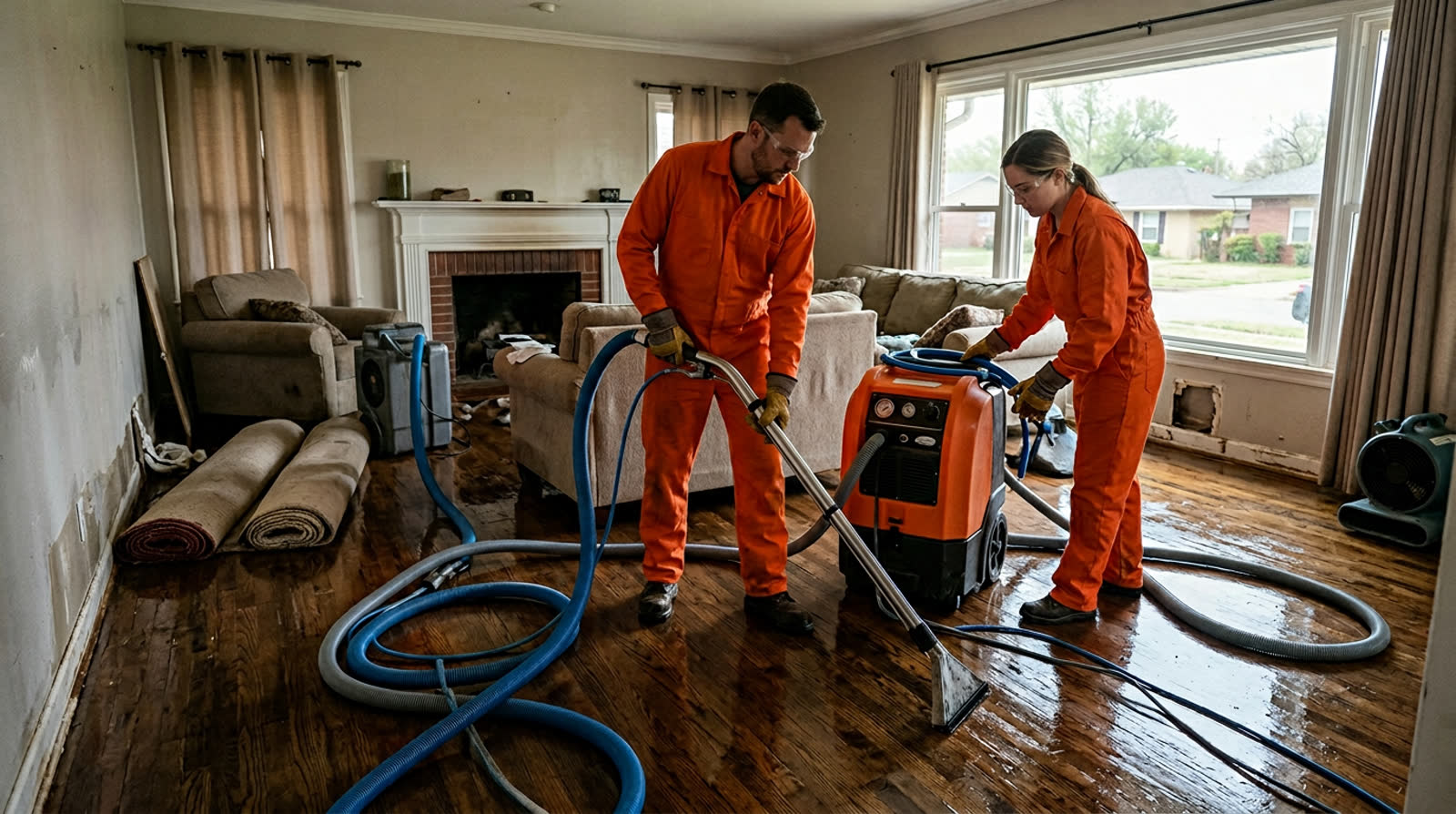
Commercial water extraction begins immediately upon arrival. We use truck-mounted or portable extractors to remove standing water from carpet, tile, and other surfaces. Office carpet typically sits over concrete slab with minimal padding, which helps. The concrete underneath can wick moisture though, requiring longer drying times than you might expect.
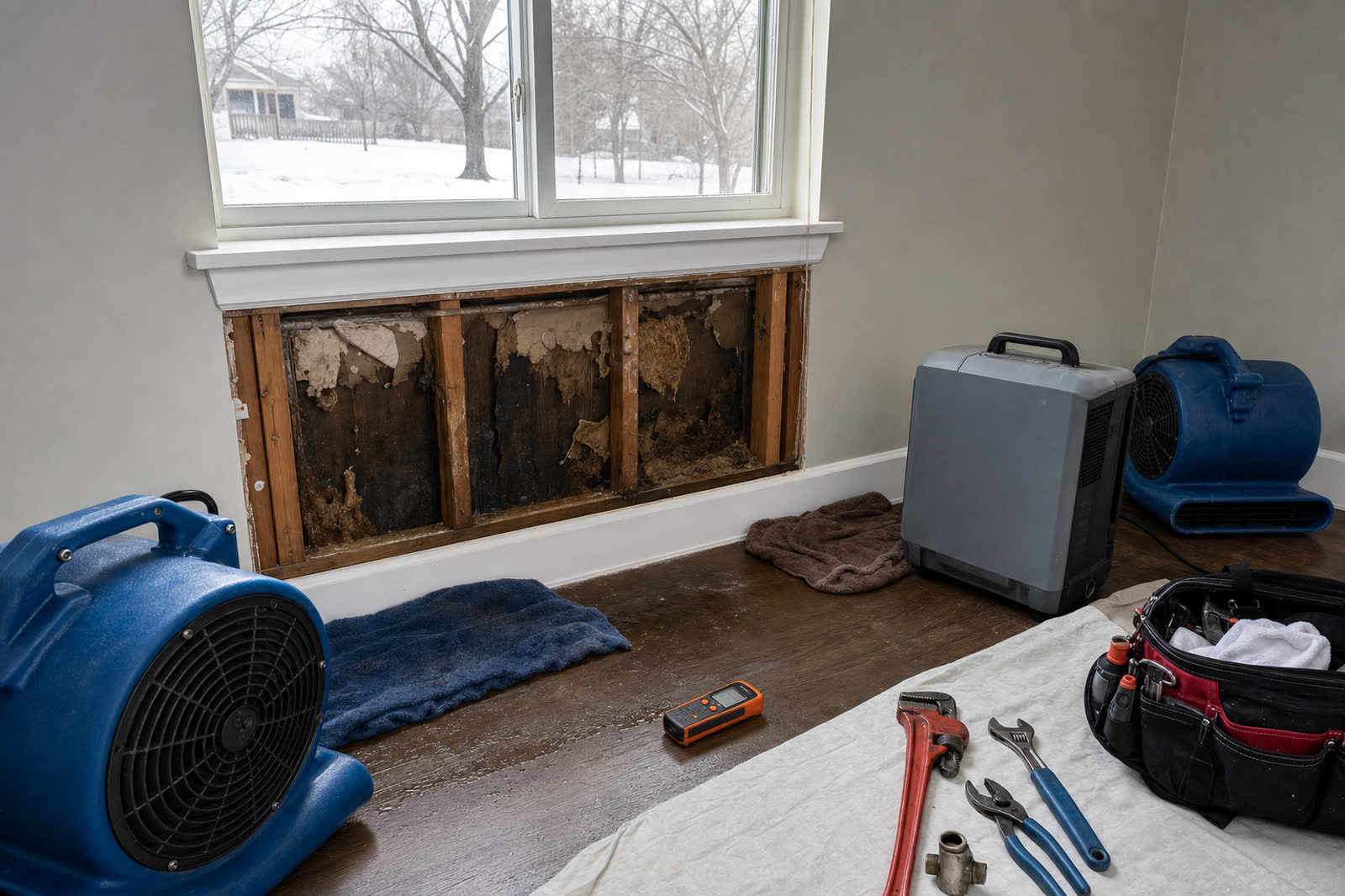
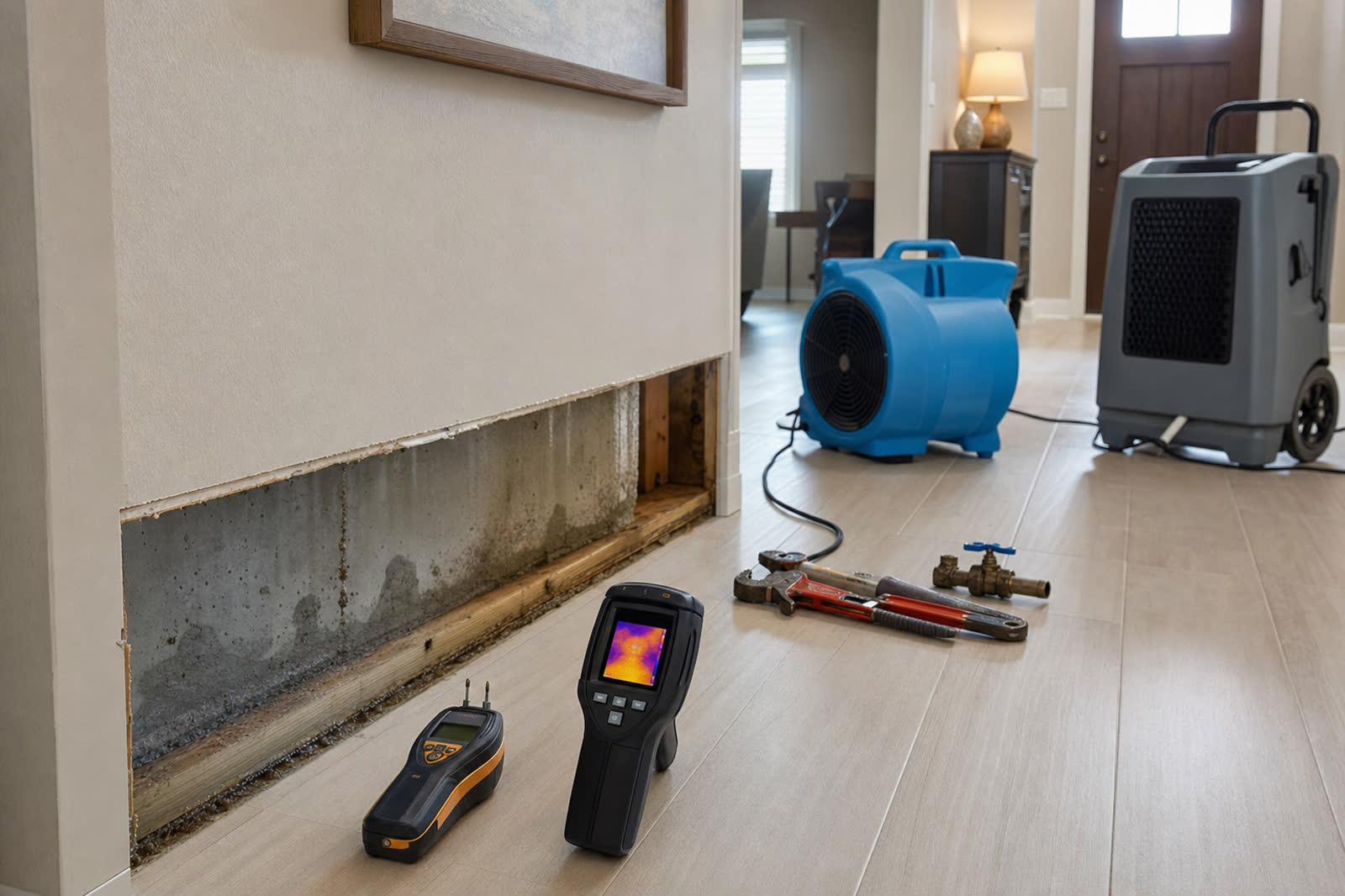
Moisture mapping comes next. We use thermal imaging cameras and moisture meters to document wet areas in walls, under flooring, and in ceiling assemblies. Commercial spaces often hide water behind modular wall panels, inside column chases, or above drop ceilings. Finding all affected areas up front prevents callbacks for musty odors or mold growth later.
Air movement and dehumidification form the core of structural drying. We place commercial-grade air movers to create airflow across wet surfaces and through wall cavities. Large-capacity dehumidifiers remove moisture from the air. Office spaces typically require one air mover per 100-150 square feet and dehumidifiers rated for the total cubic footage of affected areas.
We typically set equipment to run 24 hours daily. Many offices allow us to work evenings and weekends to avoid interrupting business operations. The noise from air movers makes normal office work difficult, so we coordinate equipment placement to leave certain areas functional if possible.
Daily moisture readings track drying progress. We return each day to document moisture levels in floors, walls, and air. Most office water losses dry to acceptable levels within 3-5 days, though concrete floors can take 5-7 days in high-humidity conditions. Oklahoma summers add humidity challenges, while winter heating helps accelerate drying.
Content handling varies by office type. Some businesses want us to pack out and store all contents so we can fully access structural materials. Others prefer in-place drying with furniture raised on blocks. We've dried everything from law offices with banker boxes of files to medical offices with sensitive patient records.
Here's what commercial drying typically involves:
- Standing water extraction with truck-mount or portable units
- Thermal imaging and moisture mapping documentation
- High-volume air mover and dehumidifier placement
- Daily monitoring and moisture reading logs
- Content manipulation (moving, lifting, or pack-out)
- Specialty drying for electronics or sensitive materials
- HVAC system inspection and duct drying if needed
- Final clearance testing and documentation
HVAC systems require special attention. If water entered ductwork or the air handler, we may need to dry or clean components before resuming normal operation. Circulating air through wet ductwork spreads moisture and can encourage microbial growth.
Can You Keep Your Office Open During Water Restoration?
Partial office operation during restoration is sometimes possible but depends on the loss extent and business type. If water affected only one section of a multi-room suite, we can often isolate equipment to that area and leave other spaces functional. This works best when wet zones have doors we can close to contain noise and equipment.
The biggest obstacle is equipment noise. Commercial air movers run at 60-75 decibels, about as loud as a vacuum cleaner. Phone calls become difficult. Client meetings are nearly impossible. We've had Edmond businesses shift to remote work for a few days rather than try operating around the equipment.
Safety concerns can force closure. If water affected electrical panels, server rooms, or created slip hazards in main walkways, keeping the office open creates liability. We won't place equipment in ways that block fire exits or create tripping hazards, which sometimes means using the entire space for drying.
Some offices relocate temporarily. Coworking spaces in Edmond or Oklahoma City can provide short-term desk space for small teams. Businesses with multiple locations may shift operations to another site. The cost of temporary space often falls outside restoration coverage, but business interruption insurance may apply depending on your policy.
We coordinate schedules to maximize your operational time. If you must use the space during business hours, we can place equipment in the evening and return for monitoring visits at times that minimize interruption. This extends the drying timeline slightly but keeps your business functional.
Honestly, full closure for 3-5 days usually makes more sense than trying to work around active restoration. Employees are more productive working remotely or taking time off than competing with equipment noise. The faster we can dry the space without access restrictions, the sooner you return to normal operations.
Customer-facing businesses face harder choices. Retail offices or service businesses that require in-person client interaction can't easily shift to remote work. We've helped these businesses section off back-office areas for drying while keeping front areas open, though this only works when water didn't reach customer spaces.
Insurance Claims for Commercial Office Water Damage
Commercial property insurance handles office water damage differently than homeowner policies. Most business policies separate building coverage from contents and business personal property. If you lease your office, the building owner's policy covers structural repairs while your tenant policy covers your contents, improvements, and business interruption.
Deductibles on commercial policies often run higher than residential policies. A $2,500 to $5,000 deductible is common for small business policies. Some policies use percentage deductibles rather than flat amounts, which can significantly affect your out-of-pocket costs on larger losses.
Documentation requirements increase substantially. Insurers expect detailed moisture logs, equipment placement diagrams, and daily progress photos. We provide this documentation as part of our service. Every air mover, dehumidifier, and labor hour gets logged and submitted with supporting moisture readings.
Business interruption coverage becomes relevant when water damage forces closure or significantly reduces operations. This coverage typically requires actual income loss documentation and has a waiting period before benefits begin. The policy language varies widely, so review your specific coverage early in the claim process.
We work directly with insurance adjusters on most commercial losses. The adjuster will visit to assess damage, verify our scope of work, and authorize mitigation costs. Having a restoration company that understands commercial claims processes helps. We've worked with adjusters from every major carrier serving Edmond businesses.
Expect these insurance process steps:
- Initial claim filing with loss description and photos
- Emergency mitigation authorization (often given quickly)
- Adjuster site visit within 24-72 hours
- Estimate review and scope agreement
- Interim payment for initial mitigation work
- Final claim settlement after all work completes
Subrogation comes into play when another party caused the water damage. If a roofing contractor's faulty work led to leaks, or a plumber's installation failed prematurely, your insurance may pursue recovery from that party. Keep all documentation about the water source and any prior maintenance or repair work.
Coinsurance clauses can reduce commercial claim payments if your coverage limits don't meet policy requirements. Many commercial policies require you to insure property at 80-90% of replacement value. Underinsuring can trigger coinsurance penalties that reduce claim payments proportionally. Review your coverage limits regularly as property values change.
What Does Office Water Restoration Cost in Edmond?
Commercial office water restoration costs depend on affected square footage, water category, and business interruption considerations. Industry data suggests small office water losses (under 1,000 square feet) typically run $3,000 to $8,000 for extraction, drying, and basic restoration. Larger losses affecting multiple suites or entire floors can reach $15,000 to $40,000 or more.
Equipment costs scale with space size. Each commercial air mover runs roughly $40-60 per day, and each large-capacity dehumidifier costs $60-100 per day in typical pricing models. A 2,000 square foot office might need 12-15 air movers and 2-3 dehumidifiers running for 4-5 days, putting equipment rental in the $3,500 to $5,000 range alone.
Labor accounts for significant cost. Commercial jobs require technicians on site for initial extraction, daily monitoring, and final equipment removal. Emergency response outside normal business hours carries premium rates. Documentation and insurance coordination add administrative time that gets factored into total costs.
Content manipulation increases expenses. If we need to pack out desks, files, and equipment to access structural materials, that labor adds up quickly. Some businesses prefer we handle all content carefully, which takes more time than simply moving items to dry areas. Electronics require special handling protocols that add cost compared to standard furniture.
Affected materials drive restoration scope. Drywall that wicks water more than 12-18 inches above the floor usually requires removal. Base trim almost always needs replacement after water contact. Carpet can be dried if addressed within 48 hours and if clean water caused the loss, but pad underneath typically needs replacement.
Here are cost factors for office water restoration:
- Square footage of affected area
- Water category (clean, gray, or black water)
- Number of days equipment runs
- Content pack-out or in-place handling
- After-hours or emergency response timing
- Specialty drying for electronics or documents
- Reconstruction needs (drywall, flooring, paint)
- Insurance deductible amount
Clean water losses cost less than contaminated water damage. A supply line break involves category 1 (clean) water that requires standard drying. A toilet overflow or HVAC condensate with biological growth involves category 2 or 3 water requiring antimicrobial treatment and more extensive material removal.
We provide detailed estimates after assessing the damage. Insurance typically covers reasonable and necessary mitigation costs, though you'll pay your deductible. We can work within insurance guidelines while ensuring your office gets properly dried and restored to prevent future problems.
Reconstruction costs run separately from mitigation. Replacing drywall, repainting, and installing new carpet or flooring adds to total expenses. Some restoration companies handle both mitigation and reconstruction. We can coordinate reconstruction through registered contractors, or your insurance may assign a separate contractor for rebuild work.
Need help now? See our full Water Damage Restoration service page or browse all restoration services. Don't see your city above? The full Oklahoma service area covers 27 cities.
Local context for this article: see our Edmond, OK restoration page and the Water Damage Restoration in Edmond service page.
This guide also pairs with emergency water mitigation and mold remediation when drying is missed.
How long does office water damage restoration take in Edmond?
Most office water restoration in Edmond takes 3-7 days for complete structural drying, depending on affected square footage and materials. Initial extraction and equipment setup happen within 4-6 hours of our arrival. We run air movers and dehumidifiers continuously, returning daily to document moisture levels. Concrete slab floors common in Edmond office buildings may extend drying time to 5-7 days. Reconstruction after drying adds another 1-3 weeks depending on the extent of material replacement needed. We work evenings and weekends when possible to minimize business interruption.
Authoritative resources referenced
Need restoration help in Oklahoma?
24/7 dispatch, IICRC standards, direct insurance billing.